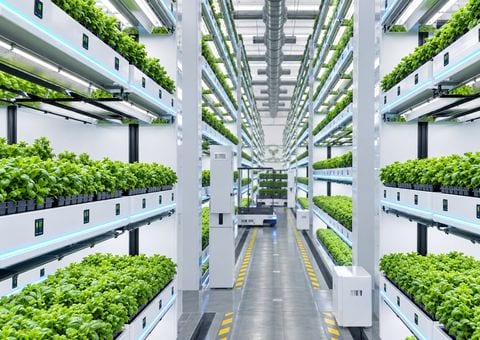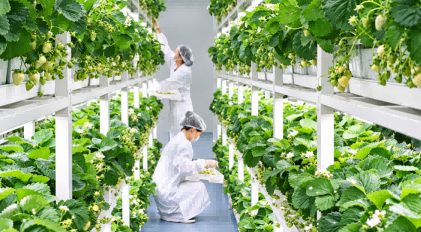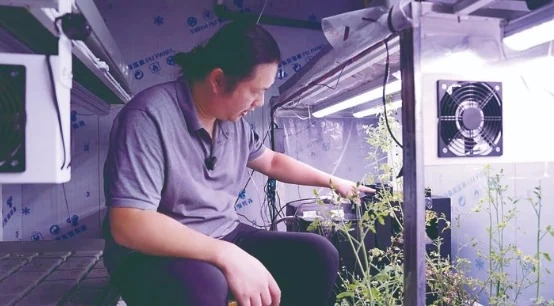
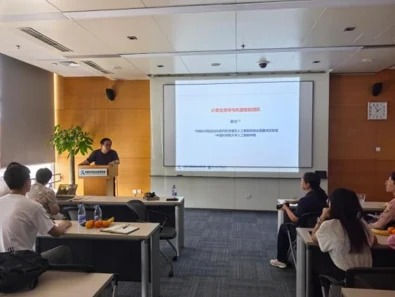
According to a notice published on July 1, 2026 by the College of Water Resources and Civil Engineering of China Agricultural University, Professor He Dongxian, a scientist of the national medicinal plant industry technology system for intelligent control, led a team to the Institute of Automation of the Chinese Academy of Sciences on June 10 for a research discussion. The team met researchers Yang Ge and Kang Mengzhen of the National Key Laboratory of Multimodal Artificial Intelligence Systems to discuss key technologies for AI-empowered plant factories.
Yang Ge presented the team’s BioBreeding 5.0 results: combining biological large language models, synthetic biology and gene editing to move breeding from conventional trait improvement toward trait customisation and artificial synthesis; and a self-developed single-cell microscopic image instance segmentation algorithm that enables high-throughput, high-precision phenotyping at the cellular scale. The two sides agreed to focus on the breeding needs of high-value medicinal plants, jointly tackle AI-driven rapid breeding technology and extend intelligent algorithms to precision control in protected agriculture.
Kang Mengzhen’s team, relying on the CAS Sino-French joint laboratory established in 1997, has worked on plant simulation modelling for more than 20 years and long studied the GreenLab functional-structural model, which can reproduce the growth and development of a crop across its full life cycle and build an organ-scale 3D growth simulation system. The two sides decided to jointly build a Pinellia-specific GreenLab model and a matching intelligent climate control system, upgrading protected cultivation management to a data-driven model of “dialogue with plants”.
The discussion brought together two technical threads in plant factories: what to grow — shortening the breeding cycle of high-value medicinal plants through molecular design and phenotyping; and how to grow it — turning growth rules into computable parameters through functional-structural models, so that climate control shifts from experience-based settings to model-based prediction.
The meeting point of the two threads is still data. Breeding needs cellular-scale phenotypic images, while cultivation needs organ-scale growth records. If the facility side cannot collect and retain such data reliably, even elaborate models are hard to apply. For equipment makers, this means sensor accuracy, imaging conditions and data interface standards are moving from optional features to basic configuration.
Medicinal plants are regarded as one of the most suitable categories for plant factories: high unit price, stable demand and sensitivity to production environments. The direction of this cooperation also confirms that the industry is concentrating resources on the combination of high-value crops and model-based control. The practical effect of these results still needs to be tested in large-scale production.
Source: College of Water Resources and Civil Engineering, China Agricultural University, “Professor He Dongxian’s team visits the CAS Institute of Automation to discuss AI-empowered plant factory technologies”